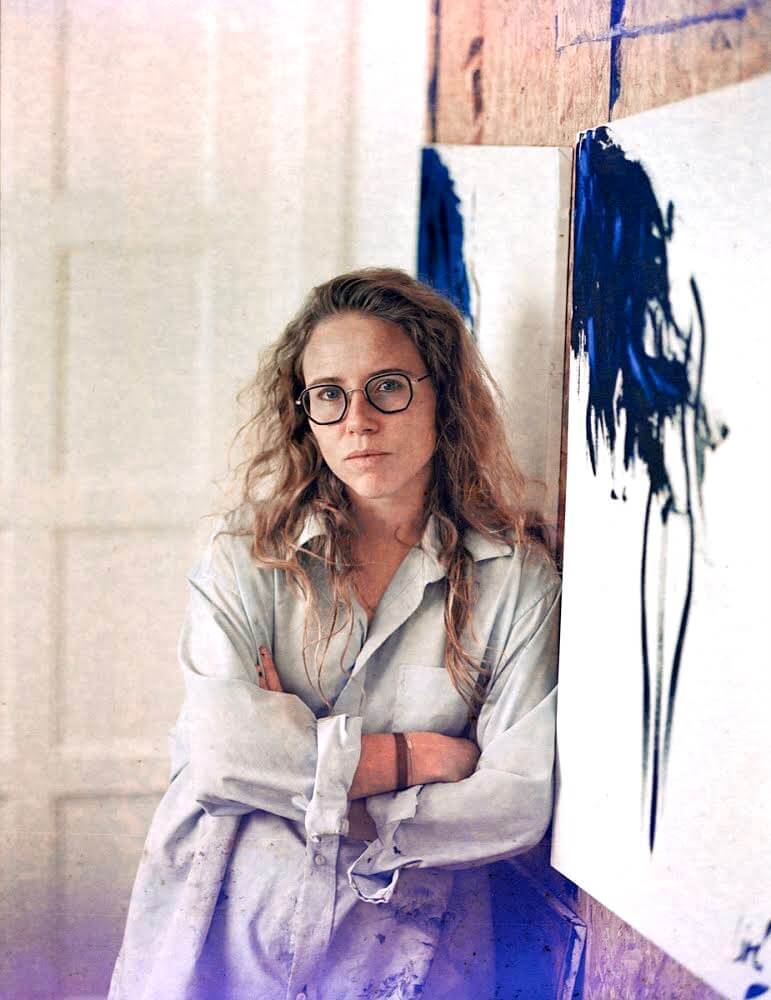
Circé’s practice begins with an exploration of the female body as a symbolic space, unfolding into an inquiry of identity and power. Her research shifts between representation and ritual metamorphosis moving through iconographies and narratives that recur.
French raised in Italy, she started showcasing her work in Mexico City in 2021.
Dissolvenze
Circé’s paintings are rooted into a familiarity with women’s bodies and feminine forms and evolve from there into a haunting space of personal and collective transformation.
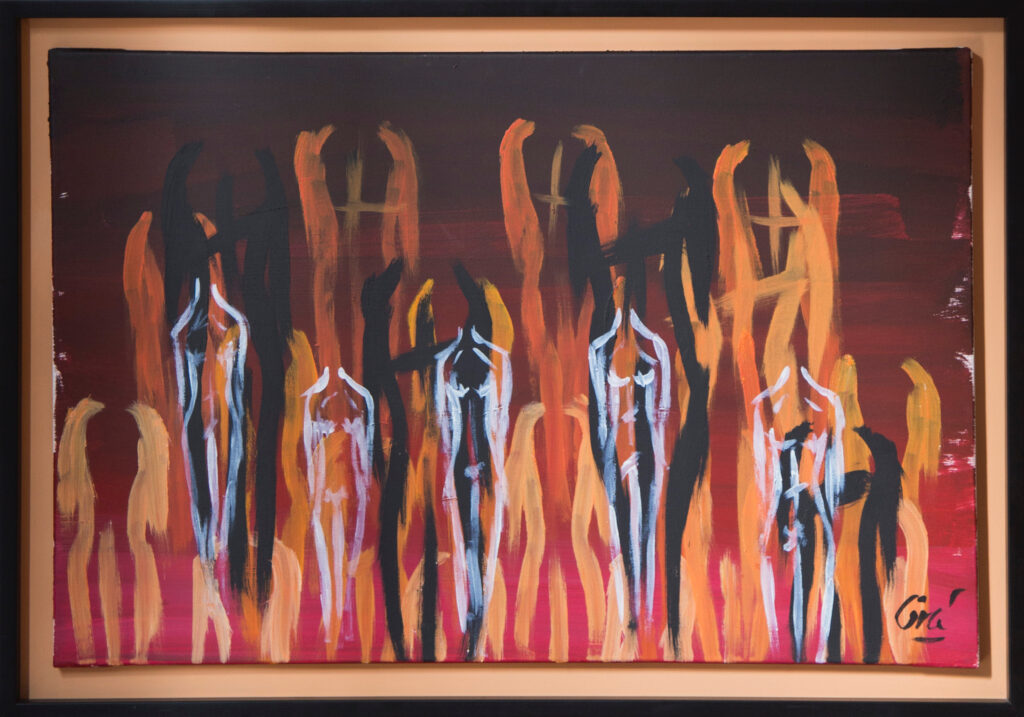
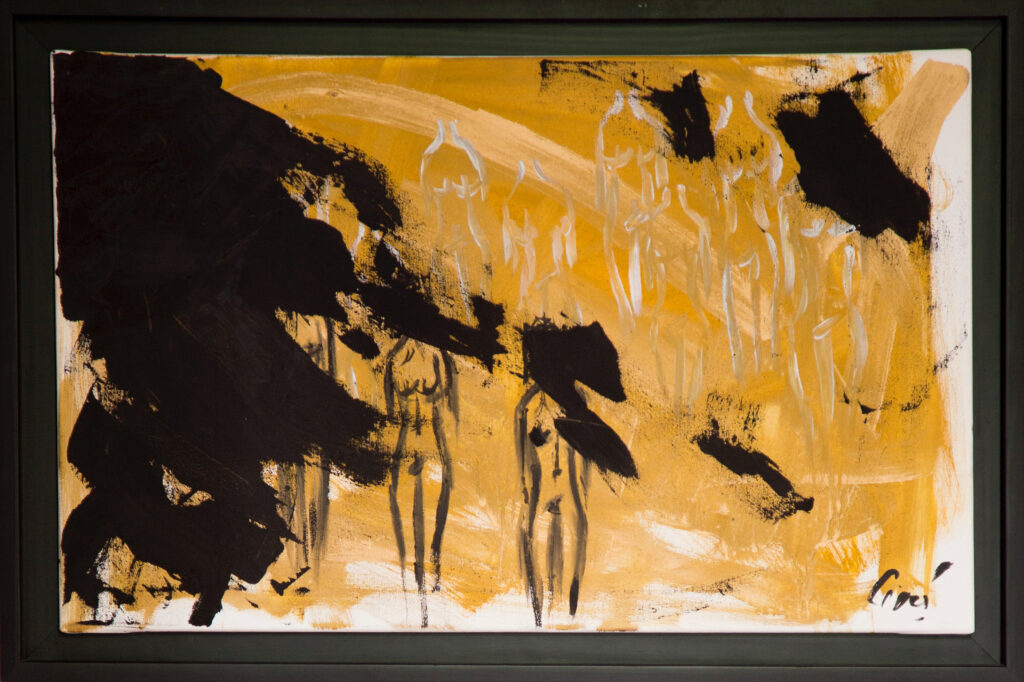
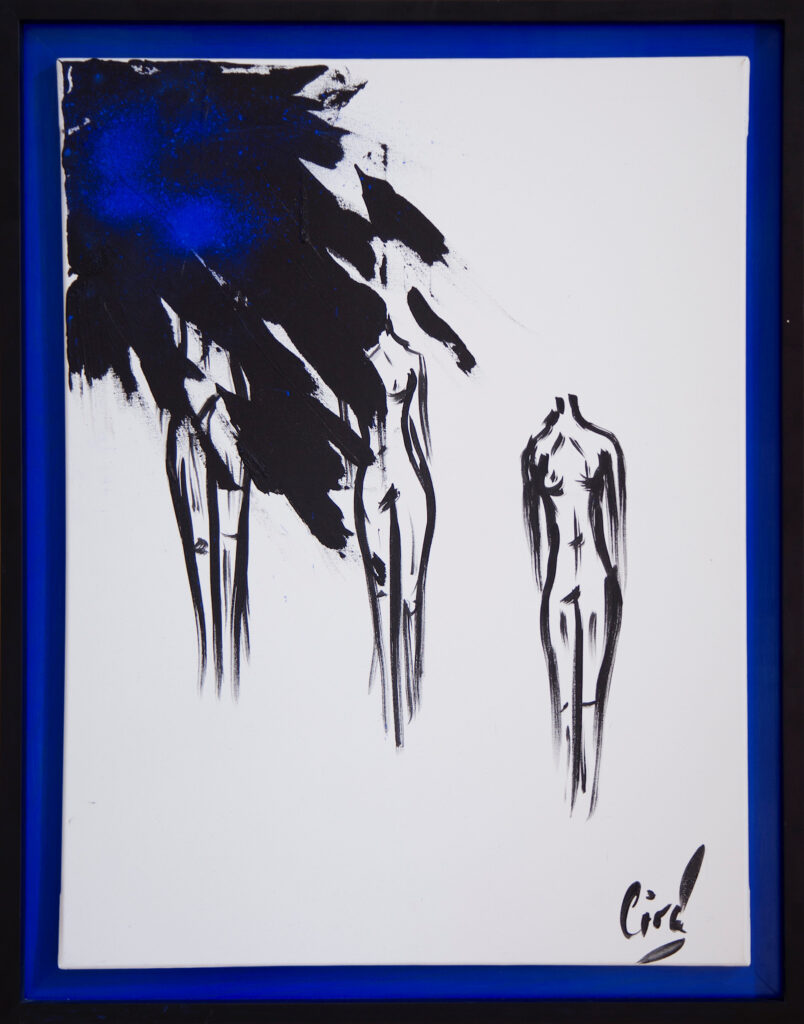
The works in this first cycle, do not reassure, feminine identity vanishes into crosses, bodies are burned on stakes as countless Joan of Arc, hellish displays of red and yellow are inhabited by faceless women as they stand in silent witness, oppression pours as a black cascade on stigmatized corpses, strokes of blue explode out of the standing figures, while others freeze in the lonely nights.
The struggle of women throughout history is showcased in a backdrop of black and white with the primary colors, red, blue and yellow as the emotional lenses of the narrated episodes, as they remain as relevant as ever even in the contemporary world.
Her decisive strokes grip the viewer to stand at the fuzzy edge between oppression and violence, they invite to consider themselves within the context of the painting.
Circé has worked with anything she had at hand. Her art is made up of a combination of acrylic paint, charcoal, crayon, and pastels, which she applies to just as broad a range of mediums, particularly tracing paper for the series Dissolvenze.
This series has been firstly exhibited in Madre Cafe in May 2021
Words from Rebecca Zissmann, for Pen Magazine
60 cm x 90 cm
Acrylic on canvas
2020
Ciudad de Mexico
50 cm x 70 cm
Acrylic on canvas
2021
Ciudad de Mexico
Blue Big Vanishing Triology 1
60 cm x 80 cm
Acrylic and pigments on canvas
2021
Ciudad de Mexico
Delirium
Delirium is a more focused cycle of works, Circé chooses a shared experience in life, pain, and grief in the immediate aftermath of their arrival and surgically isolates the agony and solitude of the afflicted. Attention is shifted to a lone subject, whose journey through desperation and insanity is represented by its corporeal experience. The cause of the suffering, the original act of violence, is removed, what remains is the destruction it leaves behind, the shattering of one’s personal identity.
Pain in Delirium is a deeply embodied and lonely experience, an invocation, a closure. The artist communicates grief as the descent into madness of desperate, contorted bodies trying to find solace in their own twisted physicality.
The paintings, while big, feel claustrophobic even the ones inhabited by multiple bodies show the crushing solitude of pain, that the artist represents as a personal journey. On the other hand, the despair series is a collection of snapshots into the physical experience of loss of a singular, inconsolable, body.
The artist’s deep black strokes emphasize the desperation of the figures while the monochromatic backdrops capture the numbness of loss.
The Delirium Series was firstly Exhibited in Madre Café during Art Week 2022
150 cm x 100 cm
Acrylic on canvas
2021
Ciudad de Mexico
Digressioni
Digressioni was born of a change of context. Immersed in the Cuban atmosphere, Circé came into contact with a different cultural and artistic environment that profoundly shaped her exploration and creative dialogue, opening new narratives and expressions in her visual work.
On the technical side, she incorporated printmaking/graphic arts into her vocabulary—skills developed during her time at the workshop of the San Alejandro School of Fine Arts in Havana, and on the theoretical side she enriched her baggage by incorporating in her work a dialogue with past and recent art history at the Instituto Superior de Arte in Cuba.
This period is characterized by an evolution in her technical capabilities. Digressioni begins as a reimagining of some earlier works, such as the Despair series, through silkscreen prints, where the power of the medium amplifies the emotions of the original drawings.
Her canvas work is likewise marked by experimentation and greater technical control, allowing her to pursue new and more complex directions.
In Fosse comuni and Uno, tutti, nessuno, the darker undertones of her poetics find both synthesis and zenith. In these large-scale paintings, the attention to detail, the use of monochromatic color, and the sheer scale catapult the viewer into a hellish dimension in which bodies tumble into one another, or stand in collective vigil, forming a human forest.
This Series has been exhibited in Mexico in February 2023
Despair Series
30 cm x 42 cm x 9
Screen printing
2022
La Habana
200 cm x 150 cm
Acrylic on canvas
2022
La Habana
En attendant Godot
30 cm x 20 cm
Sérigraphie Artisanale
Acrylic on paper
2022
La Habana
Esercizi
Esercizi is a heart-to-heart with the artist’s roots; she puts herself in dialogue with her own inspirations. Coming back to her home city of Rome, Circé chooses to begin this new chapter by revisiting old classics, reinventing them and making them her own.
The interplay between past and present, process and being, is felt throughout the series in which the poetics of the masters comes into contact with hers.
The cyclical nature of time, the idea of return and coming back, is what the artist invites us to feel in its materialization as works of art.
The need to understand memories not as information about the past, but as the ever-evolving substrate over which we build our actions and ourselves, is what is explored here: old art is reborn as new in a constant act of giving and taking, rhyming with the human condition, with the concept of coming home, and leading to the question, what is home?
This series has been exhibited in Rome in December 2022
150 cm x 100 cm
Acrylic and pigments on paper
2022
Roma
The sacrifice
150 cm x 100 cm
Acrylic and pigments on paper
2022
Roma
The sacrifice
LIVE PAINTING
300 cm x 200 cm
Acrylic and pigments on canvas
2022
Roma
Façades / Salotto Erotico
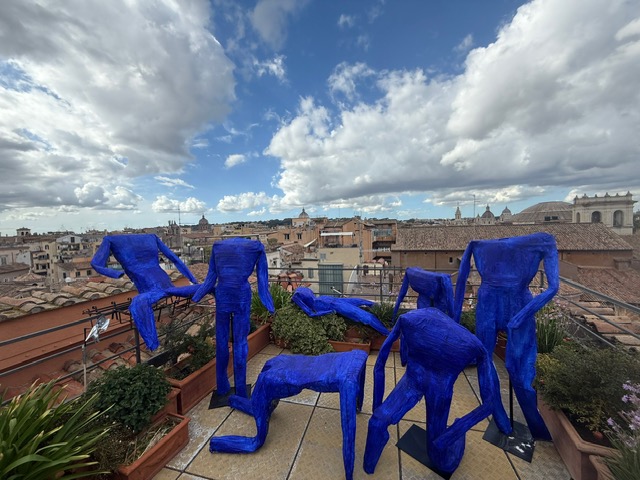
Façades presents seven headless, hollow figures that suspend the body between presence and absence. Their voids, perceptible only from behind, open the sculptures to projection, drawing desire around what is structurally missing. The decapitated forms recall Bataille’s idea of eroticism as a passage beyond reason, while their androgyny resonates with Butler’s notion of gender as performed rather than fixed. The repetition of these bodies suggests a choreography of discipline in the Foucauldian sense, yet subtle variations destabilize uniformity and allow difference to emerge.
As the artist takes her figures down from the canvas to the floor, granting them volume, she reinforces the idea of the body as vessel: an envelope awaiting inhabitation. These neutral yet deformed silhouettes resist passive contemplation; they are invitations to be filled with one’s own self, dreams, and passions. In this way, Façades shifts from static object to participatory rite, where meaning arises through the viewer’s embodied encounter with absence and form.
This pieces have been exhibited as an installation in Ciudad de México during Art Week in February 2024, and the concept re-worked for a site specific installation in Rome in 2025 part of “Une Femme est une Femme” Exhibition curated by Anna Kessler de Pretis
Façades
Sulpture
Alambre and papier maché
Ciudad de México
January 2024
Salotto Erotico
Site Specific Sculpture
Braided sheath-covered cables and plaster bandages painted with acrylic medium
Rome, August 2025